After landing: what’s the impact

When more and more young people choose to pursue entering the public sector as the best choice, the feelings after actually passing it are far more complicated than imagined.
On the one hand, it brings a sense of stability and security to those people, but sometimes lets them get into another rat race.
“Life never really has a ‘landing’ day,” said Wang Fan, the 31-year-old civil servant in Sichuan who twice took the civil service exam and gave up a job at a Big Four accounting firm for the stability of a job in the public sector.
“ You have only achieved a certain stage of your goal,” she said.
She just ended her maternity leave a few months ago and is relearning to balance her work and busier family life.
“Passing the civil service exam only means I achieved my goal of finding a job after graduation,” she said. “Now I have new worries like whether I can improve my ability to finish my work better or how I should finish this task.”
Claire Li, a 26-year-old frontline civil servant in Yunnan province, southwestern of China, echoes a similar sentiment.
After talking with her family members who are also in the public sector, Li chose to enter the public sector directly.
“The cost of taking the postgraduate entrance exam is indeed much higher than that of taking the civil service exam, like your time and money,” said Li. “Moreover, it is even possible that after you put in more effort and cost, the result you get is similar or even less satisfactory than before.”
However, Li said that “passing the exam is just a moment of happiness because you have made it”.
“When you actually step into the workplace, you will realise that you have merely switched to a different track and still need to face a great many challenges,” she added.
Even within the system, she still faces numerous assessments and mental pressures. As a grassroots-level civil servant, she mentioned that she will encounter a great many difficult issues that are hard to resolve, with all of these requiring her to enhance your capabilities.
“This feeling is particularly pronounced when dealing with work that involves direct contact with the public,” said Li.
“In many cases, it is impossible to predict the educational or cultural background of the people you will encounter in your work,” she said. “They may not necessarily understand or agree with a particular policy. In such situations, they may attribute the problem to you and even want to complain you.”
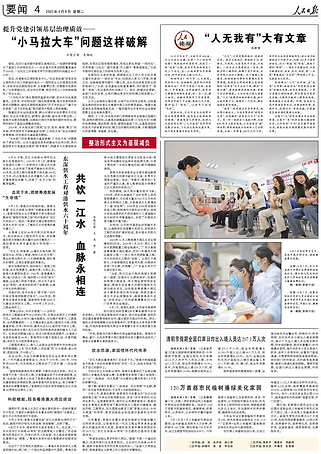
The phenomenon of "a small horse pulling a heavy load" exists among grassroots civil servants like Li, meaning they are burdened with tasks beyond their resources and capabilities, operating under a high workload, including excessive tasks, responsibilities, and pressure, which has led many who have entered government posts to experience a reality of stability but exhaustion.
Last year, Beijing announced a major push to reduce the burden on grassroots levels by addressing formalism, emphasizing the need to combat formalism to alleviate the burden on lower-level staff.
The People's Daily publishes an article last year emphasizing the need to rectify formalism to reduce the burden on the grassroots level.(From the People's Daily)
The impact of the surge in the civil service exam is actually a double-edged sword, according to Wu.
“On the positive side, the government may be able to attract more capable and better-educated recruits,” said Wu.
“But the downside is more worrying. If too much top talent crowds into the government for security rather than mission, China may see weaker entrepreneurial dynamism, fewer people willing to enter innovation-driven sectors, and a poorer allocation of human capital,”said Wu.
He noted that a healthy economy needs good civil servants, but it also needs talented young people in technology, advanced manufacturing, research, and new business formation.
“If one side becomes overwhelmingly more attractive, the whole system becomes less balanced,” he said.
Fan expects that the craze for the civil service exam will gradually intensify until 2031. After 2031, enthusiasm will begin to wane, and by around 2036, the overall heat will decline significantly.
“The overall number of recruitment positions in the national civil service exam has not seen a sharp decline these years, so as long as there are still plenty of vacancies, people will continue to apply, enroll in tuition courses and invest in preparation,” said Fan.
He explained that people currently in the system will gradually retire, and new talent will come in. After around five years, there may be enough fresh candidates inside the system. If recruitment no longer maintains the same scale, the enthusiasm for applying will naturally wane.
“To give an example, if a large number of people have been recruited in recent years, tens of thousands, you would naturally feel it is worth the investment. But if only around forty people are recruited in a given year, people will be more cautious, the motivation to apply will drop, and the enthusiasm will not be as high,” he said.
He also mentioned that “the economy will not remain in a downturn indefinitely”. As the economy gradually recovers, opportunities will become richer. With the emergence of new sectors such as AI and drone technology, the focus will gradually shift in that direction.
“Life offers more than just this one path. It is not necessarily the case that becoming a civil servant is the best option,” he said.
“When a particular sector is already highly competitive, why force your way in? It is far more important to find opportunities that suit you and align with your abilities,” he said.
Wu pointed out that for the government, how to deal with this obsession with civil service jobs is not to discourage young people from entering public service, but to make other career paths feel more rewarding.
“That means improving private-sector confidence, especially for firms that hire graduates, strengthening labor protections and social security portability so that leaving the public sector does not feel excessively risky and improving the quality and relevance of postgraduate education so that degrees are tied more closely to real skills, and building stronger school-to-work pathways in emerging industries,” said Wu.
“In short, the government should reduce the insecurity premium attached to private employment rather than simply trying to cool enthusiasm for civil service jobs,” he said.
He mentioned that China is already rolling out employment support for graduates as graduate numbers continue to rise, which points in the right direction, but the deeper challenge is restoring confidence in non-state career ladders.
The surge in applications for civil service posts is a microcosm of our times, as young people seek certainty in a highly competitive environment, reducing any risk they may face, with no absolute right or wrong when it comes to the choices people make.
Dong advises students to consider clearly what sort of life they actually want to lead before choosing the path.
“If you enjoy a quiet life, then you can sit the civil service exam. But if you feel you still want to achieve something, the civil service exam might not help you achieve that goal,” said Dong.
“Can you accept failure? Can you accept the possibility that your efforts might go unrewarded? Can you cope with the feeling of seeing others who are better than you? You need to ask yourself these questions,” she said.
“So, before you take the exam, you must first know what you want,” Dong said.